Tuesday, January 29, 2013

Writing Consultant Highlight - Sarina Labold

Writing Consultant Highlight
Sarina LaBold


Sarina is a junior English and Media Studies major. Not only is Sarina good at writing, but one of her hobbies involves a creature that most of us do not see on a daily basis. Much like the feat of tending to horses, Sarina advices her students not to panic when a large writing task is in front of you. As a self-confessed fanatic note-taker for her paper writing style, Sarina's comments will give you ease.

 See below for Sarina's insights:

As a writing consultant, you know how to put a paper together, but what is your writing process like?
My papers begin as a bunch of page numbers and scribbles on loose-leaf that look like Egyptian hieroglyphs! I designate a page for each paragraph, and as I go through my sources, I put each fact/quote on the respective page. Sometimes I just write notes from each source and then put a 1, 2, or 3 next to it to indicate what paragraph it belongs to. Really, I often amaze myself how all my muddle creates a cohesive paper in the end! 

Let’s face it: No one is perfect. What is your biggest writing challenge?
Once I feel organized enough with what I want to say (which often takes a lot of time and courage!), I just have to sit down and write. If I get interrupted, I lose my train of thought and have to re-read my paper and go through my sources again. (This goes for everything but the introduction. I like to write this the day before I start the bodies.) Unfortunately, wanting to write the paper in one fell swoop is a good excuse to procrastinate… and if I convince myself it’s not a good excuse, my perfectionism kicks in, and I tell myself it won’t be as good of a paper!

How does your major help you become a better writer? How has Cedar Crest helped you become a better writer?
Being an English writing major makes you explore many different types and styles of writing. You get to examine famous authors’ voices and make your own. For example, I just completed two writing classes where brevity and clarity were vital: a fiction piece could not exceed two pages and a poem 20 lines. This type of class really makes you sort out your literary voice! Cedar Crest also provides many contest opportunities where you have the option of getting judges’ feedback.

What is something interesting not many people know about you?
I have a horse who thinks he can fit in my pocket, a turtle who thinks he’s a dog, and a betta fish who likes to sleep half out of the water. Maybe my animals have identity issues? 

What is your favorite book? Why?
This past semester I took a class entitled “Jane Austen and Eighteenth Century Literature.” I had never read any of Jane Austen’s works before and was pleasantly surprised how much I enjoyed her novels! At the moment I think Pride and Prejudice is my favorite, though once I read Persuasion, I’m sure that will take its place.

What is your general advice to writers?
Don’t panic! Good writing will come to those who dedicate themselves to reading and understanding the formats, styles, and voices of others. Take a piece you particularly like and try to mimic the style in a piece of your own. And, as with most things, start small. Limit yourself to two pages and expand your boundaries as you grow. 


COMMENT BELOW TO OFFER SARINA YOUR QUESTIONS AND FEEDBACK!

Monday, January 21, 2013

Saying “Yes” to “No”: How to Handle Rejection and Criticism

Weak, unsupported, awkward, unclear, disorganized, problematic, confusing, wordy: Even writing these words makes me cringe.


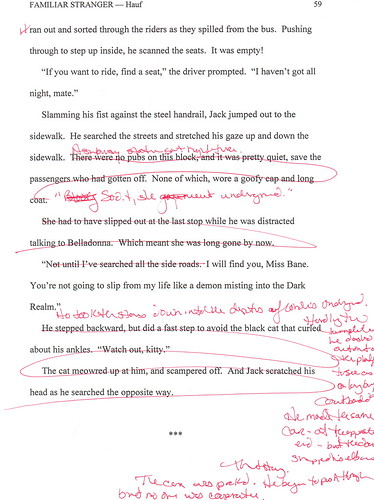
Look past the red pen!
There's a masterpiece hiding inside...
Rejection and criticism are hard to deal with, especially in
something as sensitive as writing. It’s your paper—your thoughts and ideas —that take the brunt of those harsh words. “Do they hate me??” might run through your mind.
Well, of course they don’t. They want you to improve. And constructive criticism will help you to do that. 
I know, I know: easier said than done. But, if you ever want to succeed, you must use the criticism to patch the places where you are weak. It is nearly impossible to judge your own writing, as you obviously know what you mean. If someone looks at your work and says that there is nothing wrong, find someone else who can read it. You’re not looking for trouble; you’re looking to improve. The more feedback you get, the more you can refine your writing.
You might need to sit your writing aside for some time—for months or even a year. Oftentimes this will help you to establish a more objective point of view. The paper or piece will not be fresh in your mind, and therefore you will be able to look at it anew. Plus, you will probably have written pieces in the meantime. When you look back, you will undoubtedly be surprised at how much you’ve improved. What can I say: practice makes (almost) perfect.
It difficult for any writer to ever say that their writing is perfect, so don’t expect perfection. Expect for your professor or a publisher to give you something to work on. There’s always another goal to reach.
Yes, there are times where criticism is downright nasty. It can be utterly mean. The most important thing to do is to NEVER GIVE UP! Anyone can be a wonderful writer. The more you write, the more opinions you get, the better you will be.
Having your peers workshop your paper will probably be one of the most nerve-racking things you will do. To sit in class and listen to your peers and professor discuss and analyze your work is hard. I can’t tell you how many times my piece would be workshopped and someone would blurt out, “I honestly had absolutely NO idea what you were trying to say.” It makes you want to crawl in the corner with the mouse.
Fortunately or unfortunately, we can’t do that. And don’t worry too much, because they always make sure to say the encouraging with the dispiriting. I find it helpful to make a chart of the positives and negatives as they workshop the piece, so that if I feel overwhelmed I can look at what I’ve done well.
Oh, and remember: everyone gets criticized. Look up some famous authors who were rejected: C.S. Lewis, Sylvia Plath, William Faulkner, and even Anne Frank. None of these authors wore capes. If they faced criticism and succeeded, so can you.

Monday, November 19, 2012

2012 Scare Off Short Story Contest Winner!

This Is The Way The World Ends
Sheri’ Flyte
I hated going down into the Pool Science basement. It had nothing to do with the blood spatter left behind by the Forensics students or the occasional sighting of a three inch long centipede before it skittered into a dark corner. It was the claustrophobic feeling it had. The constant ducking to avoid smacking your head into a steel pipe. Practically crawling on the floor to get underneath a vent. The complete lack of windows. Only one way to leave. Radio transmissions were sketchy at best, if you were lucky. But the fire extinguishers had to be checked, and it was my turn to go into the basement. When I walked up the stairs, finished with my task, something felt...off.
The strobe lights of the newly installed fire alarm system were flashing, but there was no sound to accompany it. Looking out the doors facing Rodale, the hazy, fog-like air lit up intermittently with the brilliant blue of the emergency phone light. I left the building hurriedly as I attempted to contact dispatch or the other officer. Nothing but radio silence and a strange haze in the night air greeted me. I caught a familiar scent on the breeze that poked at the recesses of memory, but I couldn't place it.
Getting into the patrol vehicle, I sped to the office, seeing alarm and emergency strobes emanating from every building. Once I arrived, I flew into the office to change my radio and find out what was going on. But the office was empty. It was never empty. And even with the fresh radio, I received no response from the other officer.
Running to Butz, I found that none of the students had evacuated because there was no audible alarm. I began knocking on all of the doors, yelling "Campus Police! You need to leave the building!" No one came out. Keying into each room, I found them all devoid of occupants. The same occurred in Curtis, Moore, and Steinbright. Everyone was just...gone.
I took the patrol vehicle through the streets of Allentown and Bethlehem, finding nothing but emptiness and silence. Even cricket chirps were nonexistent. I called every number in my cell phone with no results and the mist left an ash-like residue as it settled on every available surface.
As the days went by, the darkness remained and I continued to catch that scent. Like the remains of a barbeque pit, it smelled like overcooked animal flesh. A hollow sound escaped my lips echoing in the silence as I realized I was utterly alone, and a T.S. Eliot verse stormed through my head. "This is the way the world ends; Not with a bang but a whimper."
I wish he had been wrong.

Monday, November 12, 2012

Writing Consultant Highlight - Gabrielle Johnson


WRITING CONSULTANT HIGHLIGHT
Gabrielle Johnson

Gabrielle is a sophomore English major (not to mention a writing consultant candidate by default). As you will see, Gabrielle can be classified in several "-phile" categories and recognizes that her major constantly challenges her writing skills. In offering advice to other writers, Gabi may seem to be a packrat, but it is all in good planning.

  See below for Gabi's insights:

As a writing consultant, you know how to put a paper together, but what is your writing process like?
Both creatively and academically, it is the writing equivalent of a small child with their first finger-paints. It seems messy and inconsistent

Let’s face it: No one is perfect. What is your biggest writing challenge?
My time management skills are underdeveloped and often lead to me procrastinating when I probably shouldn’t. That, combined with my inability to hand in a paper I feel is inadequate, often leads to late nights adding new paragraphs and editing old ones.

How does your major help you become a better writer? How has Cedar Crest helped you become a better writer?
I am an English major, so if I can’t write I fail by default. I am constantly challenged in my classes, and the faculty is always willing to spend a bit of extra time discussing my thoughts while helping me develop them into coherent ideas.

What is something interesting not many people know about you? 
I am a bibliophile, cinephile, and music-lover. I spend far too much time listening to music, reading, or watching something. I have over six hundred books on my shelves, hundreds more on my computer, and don’t even ask me about how many albums and movies I own. 

What is your favorite book? Why?
Right now, it is Good Omens: The Nice and Accurate Prophecies of Agnes Nutter, Witch by Neil Gaiman and Terry Pratchett. The humour is dry, witty, and very reminiscent of Douglas Adams which is always a plus. And it’s always nice to see two of my favourite authors working together. 

What is your general advice to writers?
Save everything you write, even if you think it’s horrible. Whether it is academic or creative, you’d be surprised how often you can go back and find something salvageable within a bit of writing you thought was nonsense. 


COMMENT BELOW TO OFFER GABI YOUR QUESTIONS AND FEEDBACK!


Monday, November 5, 2012

Free Writing or: How I Learned to Stop Grammar and Love the Rambling


If you gaze long into an abyss, the abyss gazes also into you.

There’s something about a nice clean word document that makes you just want to keep it that way forever. The pristine whiteness. The vast expanse representing endless possibilities. Infinite chances to ensnare and captivate the reader all living in a single, empty page.

Well, that’s not completely true. 

There’s not actually some mystical epiphany inside that empty white rectangle that’s just biding time until it reveals itself to you. The word document, surprisingly, doesn’t hold the answers to your prompt question or the beginnings of your epic novel, or even next week’s winning lottery numbers, but you sure want to believe it after you’ve stared at one for a few hours and gotten nowhere. The truth is, that’s all in your own head somewhere. Except maybe the lottery numbers.

The key is unlocking it (see what I did there?). If your biggest problem when it comes to writing is getting started, your solution may lie in free writing. 

Free writing is when you give yourself a time limit, whether it be 5 or 30 minutes, and just start to write. Ignore spelling, ignore grammar, and, no matter what you do, keep typing or writing by hand or whatever method of transcribing you prefer. Keep your hands moving until the very end, even if you’re just ajandjfjfjgjgkjggnssbhshg;hhkwswjwkjktjkyjhjkk.

 It’s going to be brutal, probably the worst thing you’ve ever written and possibly the worst thing you’ve ever read, but that’s the point. When you free write you’re not trying to get any work done, you’re just trying to get into the writing mood. You know, that strange state of being where the words just pour out onto the page? That seemingly nonexistent quality you’ve only heard about in myth and whispered stories of that one girl in Curtis who wrote a 17 page research paper in one night and got an A? 

Yeah, it’s like that. And it feels fantastic.

- Gabi

Monday, October 22, 2012

Writing: It's a Virus


It's no Ebola or Lassa Fever, but writing is just as infectious.


Alrightly, you caught me.


Bacteriophages, a type of virus, taking over a cell.
Source: microbiologyonline.org.uk
I am in the midst of an immunology-crazed phase of my life. This is partly due to the fact that I recently watched the move Outbreak, which depicts/dramatizes the journey of Ebola, a very deadly virus, as it travels to America. After watching the movie and spending some time in my research lab, I began thinking about how writing is much like a virus.


I know. It’s an odd comparison, but just stay with me here.

 Viruses are simple and very small. They are only comprised of deoxyribonucleic acid (DNA) and a protein coat for protection. Even better, they are one-hundredth of the size of an average bacterium. That’s really tiny! Yet these simpletons mesmerize us with their ability to wipe out their hosts quickly and efficiently. They are able to fully commandeer a healthy cell and destroy them singlehandedly in a very short amount of time.

I’m not saying writing is going to destroy you (event though it sometimes feels like it), but the act of writing is simple as well; you can string some letters together and get a word. Then put some words in the correct order and you have a sentence. It’s very humble. Yet we are so intrigued by what this process has given us: the ability to entertain, perplex, frighten and explain every possible topic and audience in existence. We even use writing to creatively sculpt new worlds from our imaginations. An act as simple as touching a pen to paper has gotten us so far during in life.

The point I’m trying to make here is that writing infects us. It takes over our minds. When we are “in the zone” while writing, it is all we can think about. The need to get our ideas on paper overwhelms us. Even while reading a good book, our minds are inundated with images, feeling and thoughts. All of these reactions can come from a single sentence or a mere word. Writing does this to you. It is infectious. It is a virus.

I, for one, am very happy there is no antiserum to this pandemic.

-Lindsay

Monday, October 15, 2012

Writing Consultant Highlight - Lindsay Faust

Writing Consultant Highlight
Lindsay Faust


Lindsay is a sophomore Biology and Pre-Med major. Lindsay sees writing as important in her science-based studies, since writing helps her convey her ideas that could one day benefit the community. Lindsay also has a desire to travel the world and a preference for a "thriller," (and not of Michael Jackson fame) as you'll see. 


See below for Lindsay's insights:

As a writing consultant, you know how to put a paper together, but what is your writing process like?
       I try to keep things very organized. I make outlines and revise them over and over until I have a working skeleton for my paper at hand. However, as I start to write the paper, I always stay open to new ideas and concepts to incorporate into my paper. I feel that nothing is concrete until I press "Print."


Let's face it: No one is perfect. What is your biggest writing challenge?     
        I have the hardest time writing introductions and conclusions. In some of my introductions, I have a tendency to come off too strong. Yet in my conclusions, I sometimes don’t end with a strong lasting impression. It’s a mess. I know.
 
How does your major help you become a better writer? How has Cedar Crest helped you become a better writer?
      At first glance, science doesn’t seem to have many opportunities in writing. However, scientific papers on breakthrough research are written every day. Being a science major essentially pushes me to become a better writer because if I cannot express my thinking in a paper, I won’t be able to potentially make a difference in the scientific society. 
       Coming to Cedar Crest made me become a better writer by challenging me. In high school, I had always gotten praise for my writing, but when I came to Cedar Crest, I was challenged: the standards were higher, the prompts were more complex, and I constantly had to get opinions on my paper. Because of this, I am now more flexible with my writing.   
   
 What is something interesting not many people know about you?    
         I have a secret aspiration to be on the TV show The Amazing Race. I love to travel and am highly competitive. I want to travel the world!                       

 What is your favorite book? Why?
        I know it’s not a classic by any means, but I love Under the Dome by Stephen King. It’s a thriller that keeps you hanging until the last sentence. The book tells tales of corruption and greed and explores the true motives behind human life.

 What is your general advice to writers?
       When writing, always be yourself. Make your ideas come to life and write with purpose. Don’t let anyone hold you back.


COMMENT BELOW TO OFFER LINDSAY YOUR QUESTIONS AND FEEDBACK!